Diamond Buying Tips: Should You Buy a Certified or Uncertified Diamond?
When planning to buy an engagement ring, a wedding ring many people find themselves wondering: does a diamond really need to come with a certificate? Should you buy an uncertified diamond? And is an uncertified diamond actually cheaper than a certified one?
A Diamond Certificate, also known as a Diamond Grading Report, is a quality assurance document that records the details of a specific diamond — confirming whether it is a genuine natural diamond and what are its characteristics. These include the 4Cs: Carat weight, Color (whiteness), Clarity (cleanliness), and Cut (shape and faceting), as well as additional details such as fluorescence, light performance, the positions of inclusions, and symmetry proportions.
Diamond certificates are issued by several internationally recognized and reputable institutions, most notably GIA (Gemological Institute of America) and HRD (HRD Antwerp).
How Does a Diamond Get Its Own Certificate?
For a single diamond to receive a certificate, once it leaves the cutting and polishing facility, it must go through a rigorous quality inspection — using both scientific instruments and the expertise of gemologists from a recognized institution such as GIA or HRD. The stone's quality and all its characteristics are assessed and evaluated before being recorded in the institution's database, which is then printed as the certificate we see today. Think of it as an ID card for each individual diamond. For experienced buyers, simply reading a certificate — without even seeing the stone — can allow them to picture the diamond with up to 80% accuracy.
When you request a diamond certificate from a dealer and they hand you a document claiming it's a certificate, how can you actually verify that it is a legitimate certificate that can be referenced and traded?
Diamonds that have been graded by a gemological institution will have the certificate number laser-inscribed on the girdle of the stone. When you inspect it under a loupe and find alphanumeric characters engraved on the diamond, you can then search that number on the grading institution's official website. If the diamond's details appear in the database and the location of the inclusions on the stone matches, you can be confident that the stone matches its certificate.
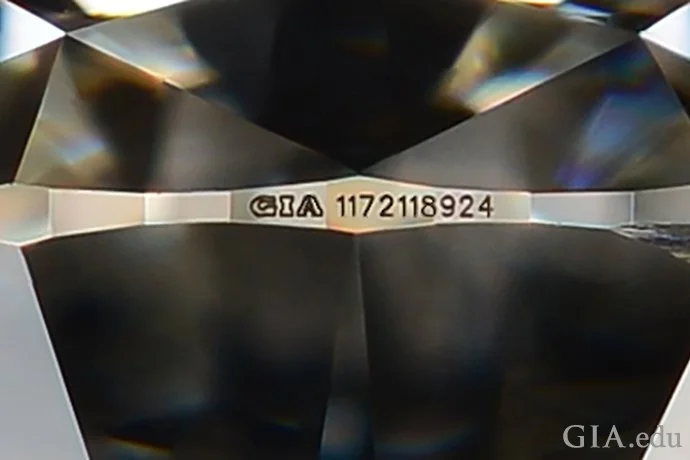
GIA laser inscription on a diamond's girdle. Cr. GIA.edu
What Does It Mean If a Diamond Has No Certificate?
Calette Diamonds believes that the absence of a certificate is precisely the loophole that allows diamond traders to set whatever price and specifications they choose — and to overstate the diamond's true quality.
Furthermore, the diamond in question could be a lab-grown diamond (Lab Grown Diamond) — a genuine diamond in terms of crystal structure, identical to a natural diamond, but created by humans rather than through the natural geological process that takes billions of years. In a laboratory, this formation process is compressed into just a few weeks.
The difference between a natural diamond and a lab-grown diamond can be detected by the presence of nitrogen (N) within the stone, which is found only in natural diamonds. Lab-grown diamonds are also priced up to 80% lower than their natural counterparts.
Buying a Certified Diamond Ensures You Get What You Pay For
Buying a certified diamond allows you to compare both price and quality accurately. For example, imagine two natural diamonds with identical stated specifications — both round, 1.01 carats, G Color, VVS2 Clarity — but from different grading institutions. Can you compare their prices using their certificates?
Yes — as long as you understand the differences in grading criteria between each institution.
Read more about how each institution's grading certificate differ: Diamond Buying Tips — Which Certificate Should You Choose? GIA or HRD
When you choose to buy a certified diamond, you are selecting a stone whose characteristics have been verified and confirmed by a highly specialized gemological institution.
It is also worth noting that today, you can have a diamond professionally graded and certificated for just a few thousand baht — whether through GIA or HRD, the pricing to obtain a certificate is not significantly different.
Buying without a certificate is essentially leaving it to chance — trusting that the dealer will sell you exactly what they claim. This is the loophole that allows traders to price diamonds above their true quality, or to pass off a lab-grown diamond as a natural one.
If you're not careful, you could end up with a diamond priced far above its actual worth — or come home with a lab-grown diamond without even knowing it.
For this reason, Calette Diamonds strongly recommends purchasing only certified diamonds from internationally recognized institutions such as GIA or HRD.
Looking for genuine GIA, HRD, or IGI certified diamonds — round or fancy cut, or would like to enquire about diamond prices, please contact us at:
Facebook: Calette Diamonds Thailand — facebook.com/CaletteDiamondsThailand
Instagram: calette_diamonds
Website: www.calettediamonds.com
Line: @CaletteDiamonds (please include the @ symbol)