Diamond Buying Tips: Should You Choose GIA or HRD Certificate?
Buying a 1-carat diamond for an engagement or wedding ring is no small decision. It takes research, price comparisons, visits to online retailers, and sometimes trips to physical stores. But with so many options on the market, how do you ensure you're getting a diamond that's genuinely worth what the seller is proposing?
Besides knowing where to buy is knowing how to buy a diamond. Calette Diamonds recommends keeping these five key principles in mind:
Understand the basic principles of diamond quality assessment, such as the 4Cs (Carat, Color, Clarity, Cut), which affect diamond pricing.
Choose diamonds that come with a grading certificate from an internationally recognized institution, such as GIA or HRD.
Study the contents of each institution's certificate carefully.
Understand the diamond grading and the key differences between GIA and HRD.
Verify that the diamond matches its certificate — check the laser inscription, use a scale, and inspect the location of the inclusions under magnification.
When buying a diamond, the certificate — also known as a Diamond Grading Report — is your best assurance of quality. It documents the stone's 4Cs (Carat, Color, Clarity, and Cut), along with other details such as fluorescence, shape, fire, and the location of any inclusions. A certificate gives you confidence both when purchasing and if you ever resell, as it confirms the diamond's authenticity.
There are several grading institutions, including GIA, HRD, and IGI. So which certificate is best? Calette Diamonds will walk you through each one, so you can read certificates accurately and use that knowledge to guide your future purchases.
When buying a diamond, the certificate — also known as a Diamond Grading Report — is your best assurance of quality. It documents the stone's 4Cs (Carat, Color, Clarity, and Cut), along with other details such as fluorescence, shape, fire, and the location of any inclusions. A certificate gives you confidence both when purchasing and if you ever resell, as it confirms the diamond's authenticity.
There are several grading institutions, including GIA, HRD, and IGI. So which certificate is best? Calette Diamonds will walk you through each one, so you can read certificates accurately and use that knowledge to guide your future purchases.
1. The GIA Certificate
The most widely recognized certificate in the world is the GIA — the Gemological Institute of America. Founded in 1931 as a non-profit organization, GIA was established to create standardized methods for analyzing and evaluating gemstones. It is widely regarded as the institution that set the global standard for diamond grading, and it trains some of the world's finest gemologists. GIA is accepted as the most rigorous and authoritative grading body in the jewelry industry, with offices in 13 countries — including Thailand.
GIA issues two types of diamond reports:
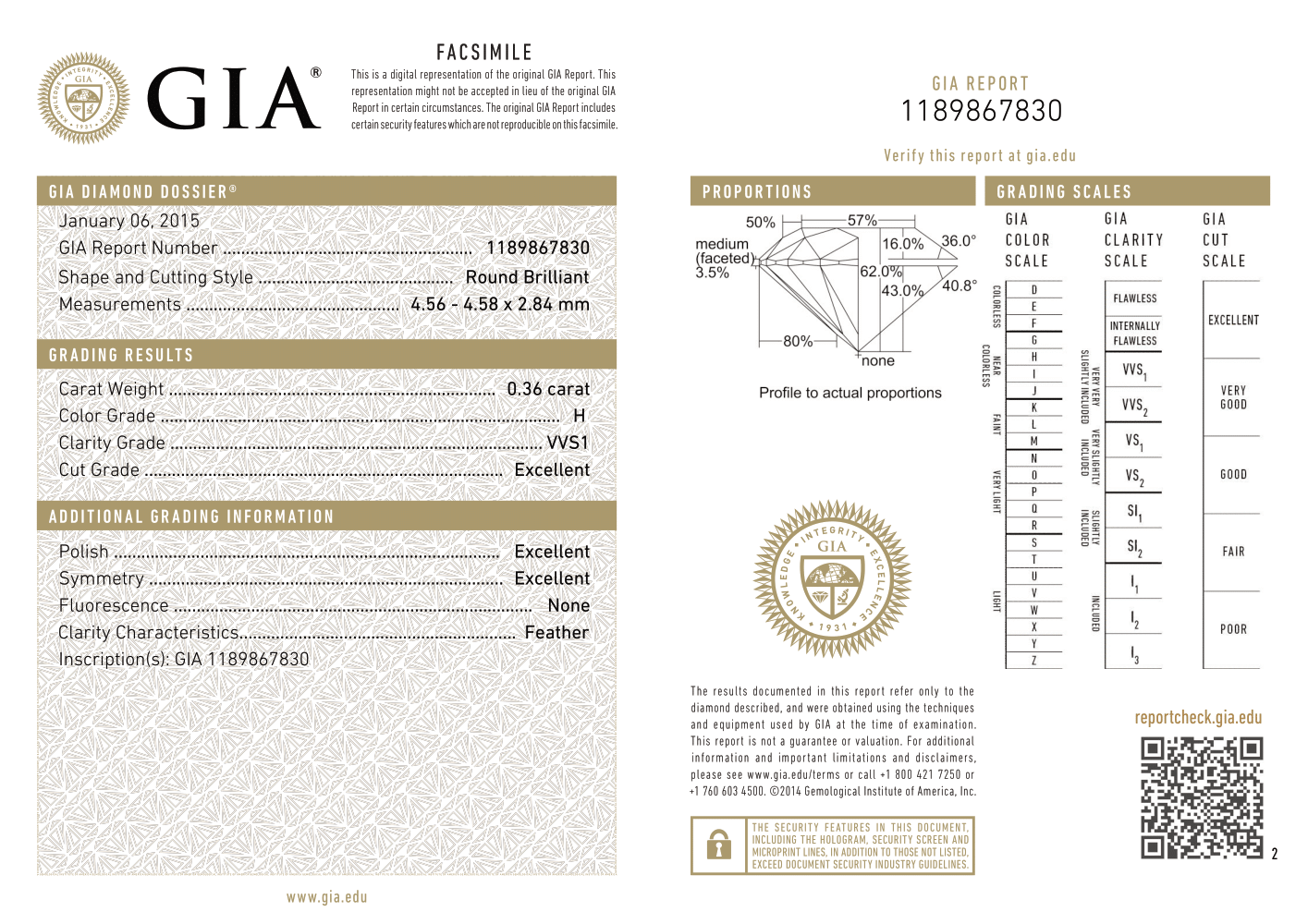
1.1 Abbreviated Report (for diamonds 0.30 ct. – 0.99 ct.)
Lists the types of inclusions present but does not indicate their exact positions within the diamond.
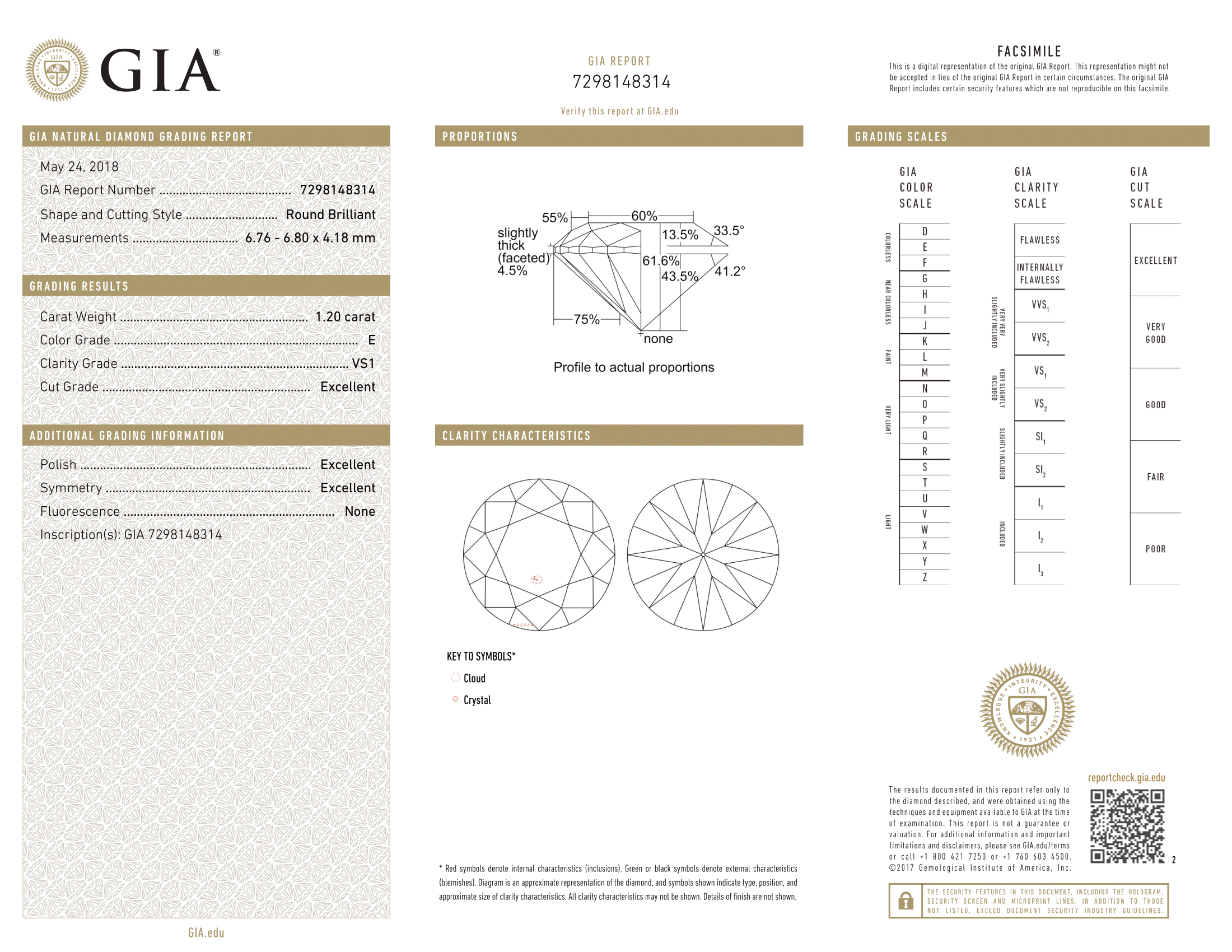
1.2 Full Report (for diamonds 1.00 ct. and above)
Includes a full inclusion map showing the exact position of each inclusion within the stone, as well as a detailed diagram of the diamond's faceting pattern.
2. The HRD Certificate
Another highly regarded certificate is the HRD — short for Hoge Raad voor Diamant (Diamond High Council). HRD is a European gemological organization founded in 1973, with its headquarters based in Antwerp, Belgium with 9 offices around the world.
HRD issues two types of reports:
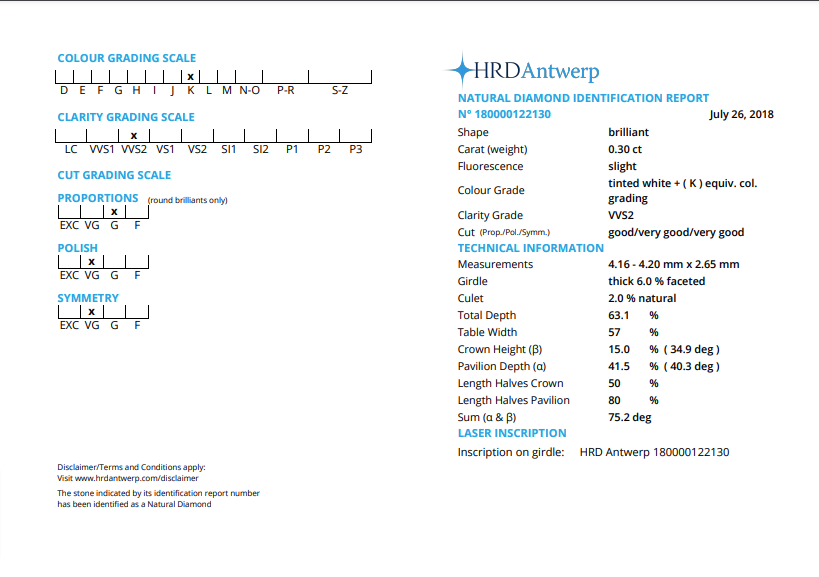
2.1 Abbreviated Report (for diamonds below 1.00 ct)
Lists inclusion types without positional mapping.
2.2 Full Report (for diamonds 1.00 ct. and above) Includes inclusion mapping and facet diagrams.
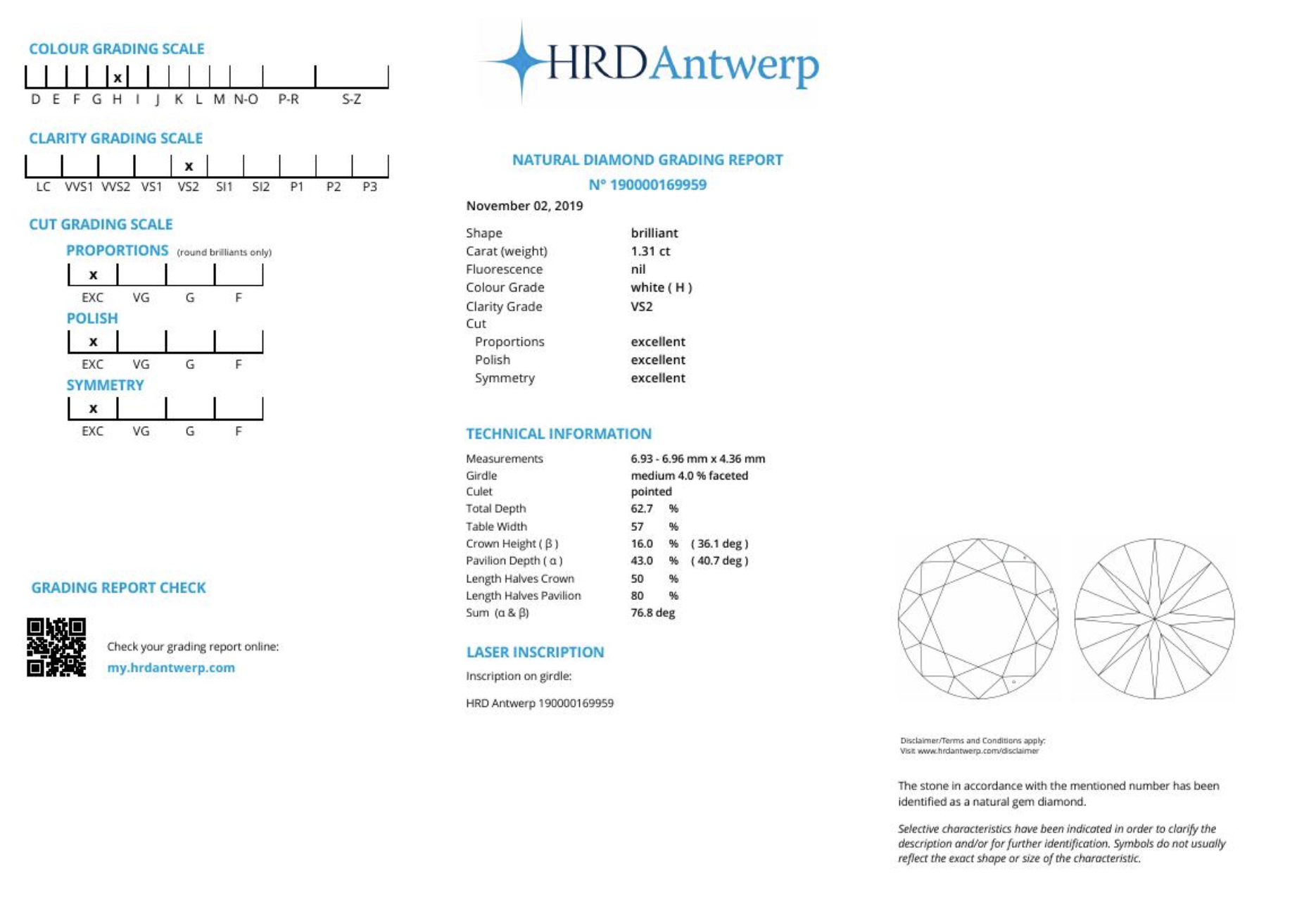
Both GIA and HRD certificates follow a broadly similar format. The abbreviated versions list inclusion types but not their locations, while the full versions include both inclusion mapping and facet layout diagrams.
How Each Institution Grades Diamonds
Both GIA and HRD use the 4Cs framework (Carat, Color, Clarity, Cut) as the foundation for grading. Their scales are broadly similar — for example, HRD's Exceptional White and Exceptional White+ color grades are equivalent to GIA's Colorless (D–E) range. See Table A for a full comparison.
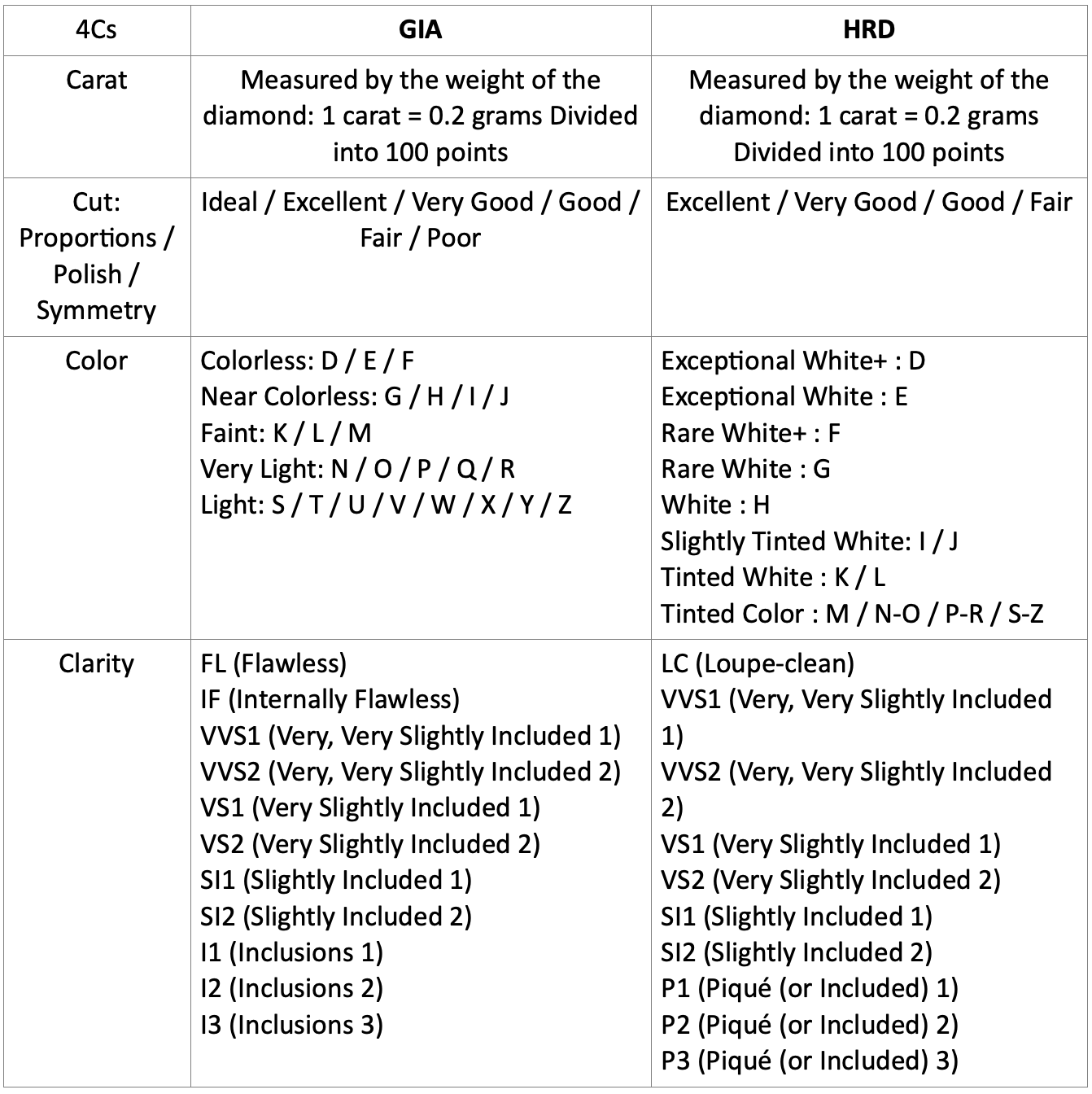
Table A
So Which Certificate Is Better — GIA or HRD?
This is the crucial question. While both institutions are reputable, their grading criteria are not identical. In practice, GIA tends to grade diamonds 1–2 grades lower than HRD for the same physical stone. See Table B for a side-by-side comparison.
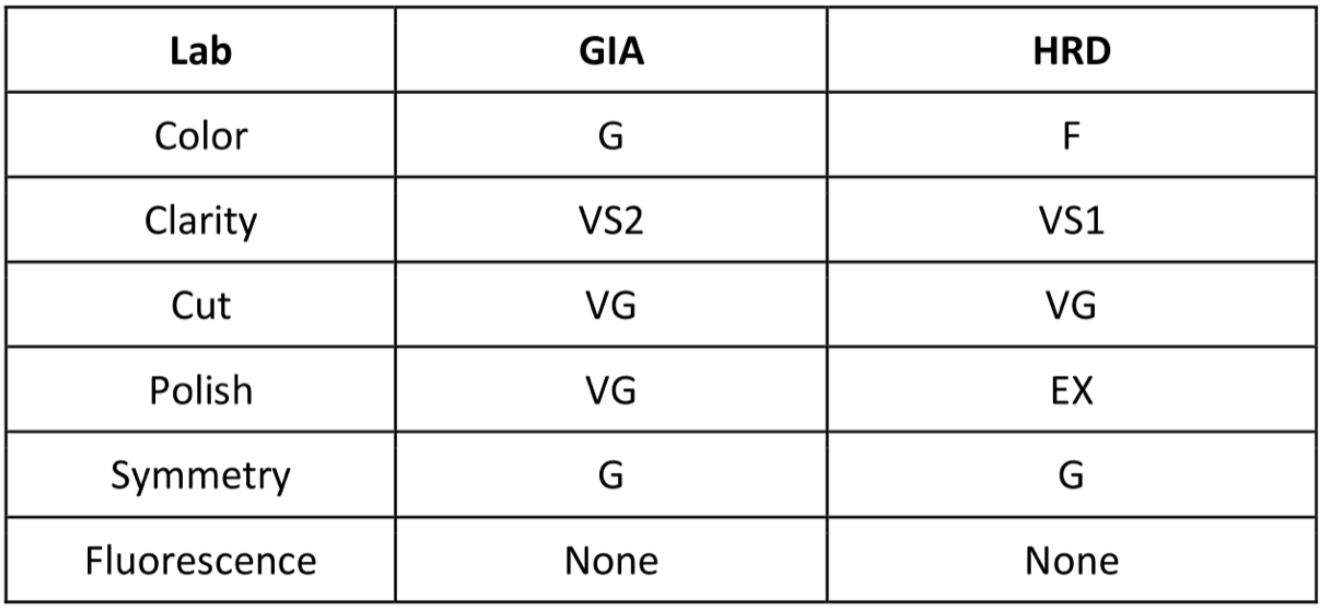
Table B
Table B is based on taking one diamond, submitting it to GIA for grading, and then submitting that same diamond to HRD. The difference in grading criteria between the two institutions becomes clear: GIA grades quality at least 1–2 grades lower than HRD.
For example, if a diamond is graded by HRD as 1 ct. F/VVS2, that exact same stone, when submitted to GIA, would very likely come back as 1 ct. G–H/VVS2–VS1.
From a buyer's perspective, an HRD diamond might appear to offer better quality at the same or lower price — making it seem like a bargain. But the reality is that HRD simply applies more generous grading criteria. Many buyers mistake this for superior quality, without realizing they are comparing diamonds graded by two different yardsticks.
It's also worth noting that GIA certificates are the most widely accepted and traded in the global diamond market. GIA is known for its rigorous, detail-oriented approach, which aims to reflect a stone's true characteristics as accurately as possible.
The common assumption that GIA diamonds are expensive while HRD diamonds are cheap is an oversimplification. A GIA certificate does not automatically mean a higher price than HRD. What matters is understanding the grading standard behind each certificate. Without that understanding, you risk paying a D-color price for an F-color diamond. But if you know what you're looking for, you might just find the perfect stone at exactly the right price.
Looking for GIA, HRD, or IGI certified round or fancy-cut diamonds? Get in touch with us through any of the following:
Facebook: Calette Diamonds เพชร GIA แหวนเพชร แหวนหมั้น
Instagram: calette_diamonds
Website: www.calettediamonds.com
Line: @Calettediamonds